You have an idea on Monday. You get an estimate on Friday. In between: two meetings, three Slack threads, and an engineer who had to stop building features to answer “Is this even possible?”
This is the meeting loop, and it's the hidden reason your product moves slower than it should.
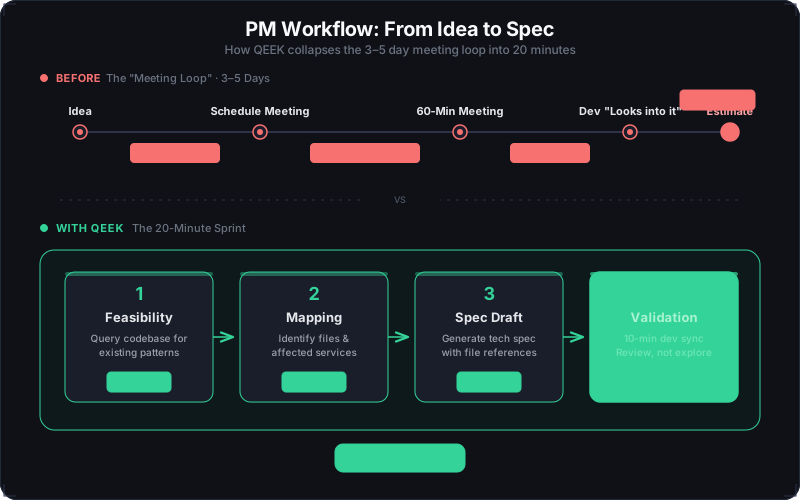
The Meeting Loop: 3–5 Days
Here's how a typical feature estimation works today:
Monday: You have an idea
You want to add batch processing to the API. Sounds straightforward. You draft a one-paragraph description and ping the tech lead.
Tuesday: You wait
The tech lead is mid-sprint. They'll “take a look” when they have a gap. You schedule a meeting for Wednesday.
Wednesday: The 60-minute exploration
You sit in a meeting while the engineer shares their screen, opens 12 files, mutters “hmm, this was refactored”, and ultimately says: “I need to look into it more.”
Thursday: More waiting
The engineer spends another 45 minutes digging into the codebase between their actual tasks. They Slack you a rough estimate.
Friday: You have an estimate
“Probably 2–3 sprints.” No written spec. No file references. Just a verbal estimate you now have to turn into a ticket.
5 days for a rough estimate. No spec. No file references.
And the engineer lost ~2 hours of deep work to answer a PM question.
The 20-Minute Sprint
With QEEK, that same PM can compress the entire Monday-to-Friday loop into a single 20-minute self-serve session. No meetings. No engineer interruptions. Here's how:
Step 1 · 5 min
Feasibility Check
Query the codebase directly:
QEEK returns cited answers with specific file paths and function signatures.
Step 2 · 5 min
Impact Mapping
Identify what needs to change:
QEEK maps the affected services, middleware, and database layers.
Step 3 · 10 min
Spec Draft
Generate a structured brief:
You get a draft with file references, scope estimate, and implementation notes.
Step 4 · 10 min
Engineer Validation
Now you pull in the engineer, but instead of a 60-minute exploration, it's a 10-minute review.
They're reading a structured brief with specific file references, not exploring from scratch. They validate, adjust, and you're done.
What Actually Changes
This isn't about replacing engineers. It's about changing when they get involved.
Today, engineers are pulled in at step one, to explore. With QEEK, they're pulled in at step four, to validate. That single shift reclaims hours of deep work every week.
Before
- ✕3–5 days from idea to estimate
- ✕60-minute exploration meetings
- ✕Verbal estimates, no written spec
- ✕Engineer explores from scratch
After
- ✓20 minutes from idea to draft spec
- ✓10-minute validation sync
- ✓Structured spec with file references
- ✓Engineer reviews, not explores
Stop Waiting. Start Querying.
The meeting loop exists because PMs don't have access to the codebase. QEEK changes that. It gives you a self-serve intelligence layer so you can do your own technical discovery, and only pull in engineers when it actually matters.