A Customer Success rep gets a message: “Does your API support batching for the /users endpoint?”
It sounds like a simple question. But in most software companies, it triggers a Knowledge Chain Reaction that costs the business roughly $250 and 48 hours of delay.
The Chain Reaction
The CS Rep doesn't know the answer
They spend 15 minutes searching outdated Notion docs. Meanwhile the customer is waiting, follow-ups start piling up, and it's harder to context-switch back to the next ticket.
Cost: ~$20 (time + open-loop stress)
The PM gets a Slack ping
They aren't sure about the latest backend refactor, so they “check the roadmap” for 20 minutes.
Cost: ~$40 (time + delayed sprint planning)
The Senior Engineer gets interrupted mid-flow
They stop coding, spend 45 minutes re-exploring the repo, and use $5 worth of AI credits to “summarize” the logic. Research from UC Irvine shows it takes an average of 23 minutes to regain deep focus after an interruption, so the real disruption is over an hour.
Cost: ~$200 (salary + 23-min refocus penalty)
The Result
Two days later, the customer gets a “Yes.”
Total Cost: ~$260
Total Delay: 48 Hours
Estimates based on average US tech salaries (Glassdoor 2025) and context-switching research from the University of California, Irvine.
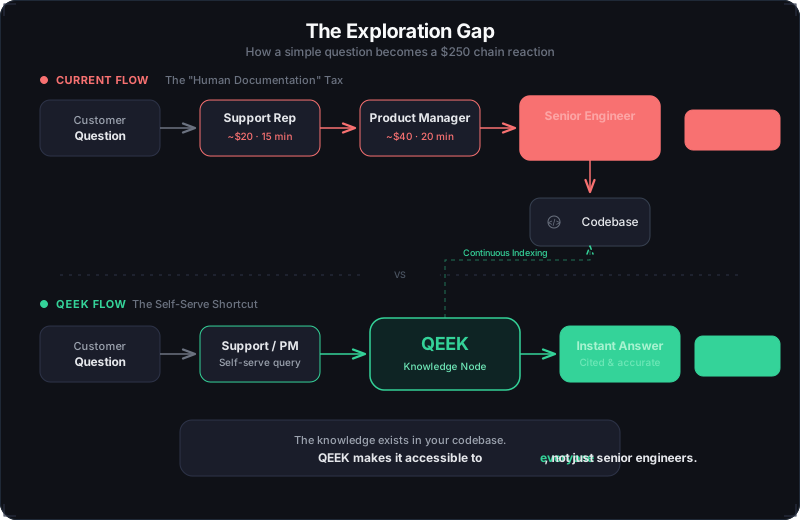
The “Exploration Gap”
This is the Exploration Gap. It's the friction between needing to know what the code does and actually knowing it.
Currently, your Senior Engineers are your “Human Documentation.” They are the only ones who can bridge this gap, which means they spend 40% of their week answering “Where is X?” instead of building “Feature Y.”
Why Existing Tools Don't Fix This
You might think: “We have Notion AI, GitHub Copilot, and Confluence search. Isn't this already solved?”
Not quite. Here's the difference:
Generic AI tools
Search text. They find documents that mention keywords, but they don't understand how your authentication flow connects to your database layer, or which service owns the /users endpoint.
Codebase-aware AI (QEEK)
Understands architecture. It maps relationships between files, functions, and services, so it can answer “Does our API support batching?” by tracing the actual code path, not just finding a doc that mentions “batch.”
The gap is a comprehension problem, not a search problem. And that's what makes the Exploration Gap so expensive: the knowledge exists in your codebase, but only your senior engineers can interpret it.
Enter QEEK: The Self-Serve Intelligence Layer
We built QEEK to kill the Exploration Gap.
QEEK indexes your entire codebase and turns it into a Product Central Knowledge Node. It allows anyone, PMs, Support, or new Devs, to ask a technical question and get a cited, architecturally-aware answer in seconds.
For PMs
Estimate feature effort in 20 minutes. Query the codebase to check feasibility, identify affected files, and draft a tech spec, all before your first meeting.
See how a PM drafted 4 specs in 25 minutesFor Support
Answer deep technical questions instantly. No Jira ticket, no engineer escalation. Just a cited, accurate answer from the actual codebase.
For Engineers
QEEK is your shield. It intercepts the “quick questions” that cost you 23 minutes of focus each time, so you can stay in flow and ship features.
For CTOs
Centralize exploration, reduce AI credit waste, and ensure your team builds on a single source of truth instead of tribal knowledge.
Stop Paying the “Question Tax”
The most expensive thing in your company shouldn't be a simple question.
With QEEK, that $250 question becomes a $1 query in AI compute. Your PMs become more technical, your Engineers stay focused, and your product moves faster.
Before QEEK
~$250 & 48 hrs
Per technical question
With QEEK
~$1 & 5 mins
In AI compute, self-serve